Saturday, June 30, 2007

Montenegro .... The Black Mountains


Spent a day in neighboring Montenegro, which means Black Mountain, named by the Italians who used to own the area - Venice.

Did you guys know that Montenegro was its own country? WHO KNEW!!!!

I have to travel with current guide books going forward. Montenegro officially separated from Serbia (yippee!) in May of 2006. In fact, it already uses the Euro, which is more than Bosnia, Croatia or Serbia can say! Here is a shot of the fishing village in the town where we caught a ferry. I took a day tour , which I usually pass on, and it was great - I learned so much more that way.What drew me to Montenegro was the old town of Kotor - what was terrific was to see that the large fjord that Kotor is on ,the largest in southern Europe, is stunning all around . Here is a shot of some of the mountains around the bay with some fishing traps in the water.

These churches are in the middle of the bay. The one of the left is Orthodox, I think. The one on the right is Catholic. The island it is on is manmade. Years ago, two fisherman found a statue of the Virgin Mary on a single rock in the water. They took it back to shore. The next day - it was gone! But turned up back on the rock - a miracle. So, local folks have sunk 80 odd boats to build a manmade island, and each year on the anniversary of the event, the MEN of the town drop rocks on the island - to continue to grow it. Its called the Lady of the Rock Church.

Enjoyed a spin around the old walled town of Kotor, a Unesco World Heritage site, then the bus took us up a hill on a 1.5 car wide road that had 26 switchbacks - for this view of the Bay of Kotor! The shot to the left is dark but shows some of the switchbacks - this particular one is in the shape of an "M", for Montenegro, or as legend has it, the Queen Melani, at the time, who the road's Italian architect had the hots for. Ubiquitous beach shot from a touristy town Budva -its the new new place to go since its still cheap. Note the "sand"... its rocks, damned rocks... and really hard to walk on. This town has lots of new hotels going in... rumor has it funded by Russian mobsters.

Montenegro is 80% mountainous - so many of the roads we were on were narrow and windy. Here is a shot of our bus being passed on a narrow road by another bus... close shot. The guide joked that Montenegrans take their driving tests on this road.
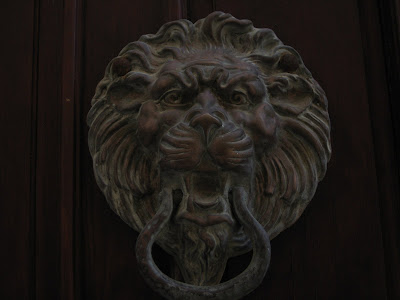


Fun doorknocker on a door in the old walled town of Budva. Fun seriously, once you have seen 6 old walled towns, you've pretty much seen them all.

Shot of part of the fort looking out to the Adriatic.


Stones stones stones. Much of Croatia and Montenegro use marble for their construction - didn't take me long to figure out it was cheap since the mountains are everywhere here.


There are cats everywhere here - so I especially liked the gargoyle that looked like a cat.


Nice peaceful scene in the old town of Budva.


You just gotta love the Cyrillic here!


A shot of Budva harbor and the mountains that extend to the sea. Montenegro used to be quite a tourist destination for the rich and famous -but hit hard times when the 12 year embargo of Serbia after the war included Montenegro. They are seeing a rebound. There was a brief shot of Montenegro in the last James Bond movie with Daniel Craig ( note to myself - see this movie again and look at scenery this time).


Oddly enough, I was in Budvar Montenegro 10 days before the Stones held a concert on the beach. I remember thinking , how much more money do these jerks need.


And I especially thought that when I heard that the annual monthly salary in Montenegro is 150 to 300 Euro a month - the folks going to see the Stones will be Russian mob guys, not local folks. Here is a shot of a house we passed 5 minutes beyond the posh beach where the concert will be held.


Last shot - on the bus watching our guide get us through the border check of Montenegro back into Croatia. This is an easy task these days - we didn't even have to flash the passports on this stop.

Dubrovnik

Hello from sunny and gorgeous Dubrovnik, the Pearl of the Adriatic. The Dalmatian coastline (named for the multitudes of feral Dalmatians) is dramatic beyond my expectations - and has already been "discovered" by northern and Italian Europeans. I can tell because the tourists are getting fatter (Germans, not Italians).

Here is a shot from the walls surrounding Dubrovnik out towards the island just offshore - looks like Greece doesn't it. Below, a shot of the mountains further up the coast where I stayed a few days before heading to Dubrovnik. Dramatic!
Above, another beach shot, albeit a pebble beach (hey, that is so NorCal!). This is from a town north of Dubrovnik. I liked to get good and hot - then go and float on my back in the Adriatic and look at those mountains.

From the fountain in Dubrovnik -people used to get their drinking water from this centrail fountain.

Took a turn around the walls of Dubrovik - they have protected the city from would be invaders like Venice for centuries - only Napolean succeed in breaching them. WARNING -MORE WAR COMMENTARY COMING......In Dec 1991, after a seige from the hills above town and the sea, the Serbs started bombing the entire area, including the old town surrounded by these walls. No military purpose, just to be dicks. 80% of the roofs were destroyed, 100 people killed in town, and 200 Croatian troops killed, some in hand to hand combat, over the next 8 months. You can see the new bright orange tiles on these roofs next to the older undamaged ones.

Europe's clothes dryer!


A charming "street" - they are shown as streets on the map but are more like staircases and alleys. Didn't need the width 1,000 years ago when they didn't have cars.


Interesting architecture. The windows all have shutters which are shut midday to keep the heat out. All stone architecture.


A view back towards the main "new" section of Dubrovnik. The stone building to the left is another fortress frequently used for the Dubrovnik Arts Festival. The guy who plays Lucca on ER, Gorin Iamababeic, occasionally acts in plays there. Like we care if he can act.


A view along the walls up to a corner fort. The Serbs took those hills inthe background and then shelled the city from them.

I bet you are happy that I am leaving the war zone tomorrow -I am a bit obsessed with it!


Cats cats everywhere!!!!!!!!!!!!!!!!!!!!!!!!!!!!!!!


Shot above is of the main drag in the old town - the major activity is eating ice cream , sitting at a table paying too much for coffee, or strutting your stuff. Note the street - its paved with marble... so slick it reflect light... I think it would be fun to sit under an umbrella while it rained and watch tourists slip and fall.

Swimmers on the rocks just outside the old town walls. Sorry Adil -they all have their tops on!


Still a major fishing area - the area hasn't been overfished by large commercial boats yet, mostly family owned.


Towards the end of "our" walk around the town - the walls are 2km long, 3-6 meters thick, and as high as 26 metres. A highlight of my stay in Dubrovnik.
I can already hear my nieces saying "YUCKKKK"... squid of all sizes!


Saw this in English with Croatian subtitles... I listened to the English. George gave it a Thumbs UP!!


Took a tour of town with a ...... Yes, indeed War theme! The guide was a local and had many color stories I intend to capture in a separate message. Here is he standing in front of a map of the old town of Dubrovnik with dots for every Serbian bomb dropped on the city, plus red for houses that burned down.


A shot of my birthday dinner - ate at a restaurant at Lapad Bay, facing a western sunset - very nice. I was visited by a Cheese Bandit - this little bird was very aggressive and managed to take a piece of cheese as big as his head. The bottle to the left is 200 ml, or about a quarter of a regular wine bottle, to give you some idea of how small he was.

Sunset at the same spot below.


Walking back from dinner came upon this family who had a pretty pooped looking kid who still wouldn't give up his beach ball.


Shot of the place I am staying. Staying in a private home is very common in Croatia - they are called Sobes, and usually involve a woman hosting you in a bedroom in her house, while you share her bathroom. My hostess Ivana, has a great garden outside, where I could take my morning coffee and read or journal. She also has a 1 year old german shepard named Bellina, who would not stop pestering the little gray kitten who also lives here.


Beautiful Bosnia


Arrived in Sarajevo, Bosnia after probably the worst train ride I have ever taken. Not trying to be dramatic - but let's say it was 13 hours in a car roughly 90 degrees all day, dirty windows with condensation so you couldn't see, toilets that backed up and repeated stops every 30 feet for no reason..... arghhhh ! I gladly overpaid for a hotel so I could shower and watch CNN while I drank gallons of liquids to recover. But I have learned that bad arrivals for me usually turn into great visits, and Sarajevo is no exception.


This is a stunning town - and all the more sad that it is still so war damaged (huh,is that superficial of me, like being sadder when an attractive person dies vs an ugly one... hmmmm). Sarajevo is situated between mountains ranges with a river running through it. Houses run up the side of the hills and overlook the modern downtown as well as the old Turkish town, shown in the pics to the side. Bosnia (as I am sure ALL of you know), is mix of Muslims, Catholics (Croats) and Serbs (Orthodox) people. Sarajevo is in the Muslim area and heavily influenced by the Turkish occupations over the centuries.

A few blocks from my hotel as I walked down the hill, I already saw evidence of the damage of the war. Here are sniper bullet marks still showing.. you see them all over. In 1991, the Bosnian Serbs, with help from the former Yugoslavian army and Slobodan Milosevic, surrounded mostly Muslim Sarajevo, and began a deliberate war of terror on its citizens. The serb commanders told their troops to fire, fire fire and completely break the spirit of the Sarajevans.

It really shook me to see apartment buildings like the one to the left. The walls would be completely pocked by bullet marks.... and you realize looking at this that the Serbs were targeting people in their homes. Not only walking out on the street on Sniper Alley, the main thoroughfare through town, but trying to kill people in their homes. Just trying to live and raise their kids. Pure terror. I hate the Serbs... that is simplistic but I just can't get to a point where I can understand dehumanizing people to this degree without some complicity.


Here is a famous spot - the Latin Bridge. Here, on June 28th, 1914 (yes, my birthday) a Bosnian Serb shot and killed Archduke Francis Ferdinand of Austria - he was the heir apparent to the Austrio-Hungarian empire, which occupied Bosnia at the time, and the Serb shot him to draw attention to Serbian independence. This local Bosnia incident had a domino effect when aligned countries fell in step.... and thus World War I started. Winston Churchill said, "The Balkans are able to generate more history than they can absorb". This was pointed to this incident but recent events show it continues.

It was about 137 degrees that day - so hot - but this local woman was walking in a coat......

Between hydrating, I shopping in the many little stalls and alleyways. The speciality here is very beautiful and detailed silver work, especially little Turkish coffee sets. Having to live out of a suitcase for 4 months prevented any purchases!


One thing that surprised me is how unbelievably gorgeous the country is. Here is a shot on the way from Sarajevo to Mostar, following a lovely river with spectacular views of the mountains. Bosnia would make a great playground for sporty tourists that like biking, hiking and rafting..... if it weren't for all the land mines that remain off the more beaten tracks.


Last war shot, I swear. A bombed out building in Mostar - only this city was not bombed by the Serbs, but by the Catholic Croats. The Muslims are simply caught between two more nationalistically violent groups. More musings on the war in a later section.


Mostar was another lovely city -again, between mountains, with a river in the middle. The town is divided along Croat and Muslim lines to this day. I spent my time in the Muslim Turkish old town and the bridge. Here is a shot at dusk walking around the Turkish Old town. It was an overwhelming sensory experience - could see so many exotic things and people, smell incense, and hear music of all types. Amazing. Note the minaret of a mosque in the background.


Ahhhhh , the Mostar Bridge at last - see it behind me in the distance. Its called Stari Most - and is 700 years old. The Croats made a symbolically deliberate and militarily pointless decision to destroy it. The people rebuilt the bridge using at much of the original stone as possible after retrieving it from the river, and had a huge ceremony to mark that occasion (thank you Azur for the video).

Its surrounded by several buildings that have been used as prisons or armories over the years.


Young men in town jump from the bridge - yikes!
Sitting at dinner looking at the bridge with the view to the left and below - I was delighted to see fireworks go off on the hill across the way. I kinda have a crush on this bridge -can you tell?


Next up, Medagorie, Bosnia. I met some guys in Sarajevo that were headed to Mostar, so I got a ride with them. They invited me to keep going so I got to see stuff like Medagorie, which I wouldn't have seen otherwise. A very weird place. In 19814, 6 kids saw a vision of the Virgin Mary on the hill above their small town. (hmmmm, does anyone else suspect they had homework to do?). They told people and from there things snowballed and Medagorie has thousands and thousands of Catholic tourists visit each day! Its not sanctioned by the Vatican, but people come anyway. If for no other reason, I appreciated the fact that they had slightly different tourist trinkets here than most places - see below.
Also stopped at a nice waterfall oasis near the border with Croatia.

On to the Croatian coast and Dubrovnik next!


Monday, June 18, 2007

Painted Monasteries of Bucovina

Romania has several regions in the north that intrigued me..... but I thought were too remote to get to, or at least too difficult to travel to. One is Bucovina, the northern part of Moldova, Romania's eastern region. In the 14th-16th centuries, the Romanian kings sponsored and built Christian Orthodox monestaries in this hilly region - and what makes them unique and incredible is that they are painted on the outside and inside. More on that later. My new friend Mihai from the pension in Sighasoara encouraged me to rent a car so that I could more easily get to this area.... trains would have gotten me near but not there. And he also asked if his 15 year old son Mihai Jr. could go. I was floored by his trust - but that is indeed what happened - Jr and I got in the car and headed about 300 KM to the northeast. What I didn't expect was how beautiful the countryside would be. Romania has the Carpathian mountain range running like a backwards "C" in the middle of the countryside - so travelling around the country requires a bit of mountain driving. The picture above is a gorge we drove through - it reminded me of Yosemite, though I am not sure if it was granite.

Various landscapes we passed on the way - I liked the haystacks in this picture with people working the fields near them.. with the hills in the distance.


Churches everywhere. Many had shiny metal roofs.... I asked our guide if that was a regional style ....... and he said, no, its lead, its cheap and we aren't allowed to use asbestos anymore.Okay!

Had to pass through several larger cities on the way... really had to mind the road since there are few traffic lights even in bigger cities, and the lights are to the right , not above as in the US. Here is a shot of an older apartment building so you could guess at what cities looked like under Communist rule.

Arrived at our destination, Suceava, and met up with our guide, Ciprian, shown here on the left with his fiance Irina , her brother and Jr. Originally, I had asked Ciprian to guide us for one day around the monestaries - but he offered to continue with us to Maramures, where the traditional Romanian villages were located. This turned out to be a godsend since we learned so much more, had more local experiences, and I didn't have to drive!
Stayed at a guest house the first night near Suceava - many people seem to rent rooms in their original houses (which are very large - no one here believes me when I tell them their house is twice as big as mine!) and live in smaller cottages in the back of the property. I slept in what looked like a dining room - and I really liked the ceiling treatment.... STALAGTITES BABY!!!
So - here's the deal on the monestaries. They were commissioned to be painted on the inside AND outside in order to educate the illiterate population on the biblical stories. They have the same general format and themes... with some variation. They also have long overhanging roofs to protect the outside painting. Bear in mind that these paintings were gone 500-600 years ago - and have not been retouched - they have only been cleaned. Magnificent.... these pictures don't capture the colors or details well.
First monestary was Suchevitsa. This shot shows Jacob's Ladder on the right. The left is the outside of the nave which at every monestary shows the saints, apostles, etc the same order to allow consistency across the monestaries.
There was a section on philosophers and here is Plato, I think, contemplating death - you can tell by the coffin and corpse above his head.


These images appeared everywhere - Seraphans, I think. Our guide, Ciprian, is grinding his teeth with all the mistakes I will make describing the monestaries !!!! The Eye image I believe is one of the original Christian symbols.

A recurring theme is about resisting temptation.


Another dude contemplating death.We couldn't take pictures inside the buildings but the painting there was even more brilliant. The first room would have a calendar system on the wall - a series of paintings for each day of the year.


I think this is a building at the second monestary, Moldevitsa. These monestaries are in the middle of a compound with a medieval stone wall surrounding them, and housing for the NUNs that live there. Yes, there are nuns, not monks. Dunno why. The statue to the left is of the king (Stephen the Great, I think) who built the monestary.
Much of the themes are about adversity of the faith. Here is a section illustrating the seige of Constantinople against the Turks.


Beautiful images.

Inside the altar area, you would find the same themes.... Passion of Christ story.... and a picture of the sponsoring king or noble presenting a mini-monestary (imagine the Stonehenge model from Spinal Tap) to Jesus... with someone, usually, Mary, acting as witness to the gift.

Guys on horses... I kinda stopped taking notes since it was overwhelming.


A broader view of the wall, I think at the third monestary, Humor. They each have a dominant color scheme - Humor is green and red.


This shows how the paintings are protected by the overhaning roof. Some sides were consistently damaged by weather, usually the north sides.


I liked this guy.


These panels represent a saint, maybe John,who refused to declare himself Moslem to the Turkish king.... so he was beheaded in the picture on the left.


Many of the characters wore these checked robes... kinda fun. Remember, this is not Catholic, its Orthodox.


Perhaps my favorite one was Veronets, known for its brilliant blue paint. But I liked it because of the back of the church, representing the great flood , I think. Here is a macro shot.
Closeups from the macro shot above. These are probably some kind of infidel.


Liked the octopus!


This guy didn't make it.


Last Judgement again.. an elephant and lion are shown.


Full shot of Veronets. Our last monestary.

Next up! A precarious ride across the mountains to the most isolated region of Romania - Maramures!


Stepping Back in Time - Northern Romania


Maramures..... the last intact area of Europe with peasant villages that follow traditions of a hundred years ago. Its a series of villages surrounded by mountains.... and the roads are horribly pot-holed and difficult to traverse.... thus isolating these towns to some degree from the Communists and from rampant commercialism (though you can feel it coming.) These gents are from the village where we stayed for two nights, Botiza.

Maramures is known for its fine carpentry - including elaborate gates. This gate is on top of the highest mountain pass in the area - between the monestary area (Bucovina) and Maramures. They are building a church at the pass, as you can tell.


Here is a house in our village. Beautifully carved wooden gate, and a woven fence. Very pretty.


Here is our hostess... she rented out the rooms we slept in in a large house and slept in the cottage to the right. This is her backyard -chickens and all. Note the large church in the background. Bathrooms in this rural town had hot water heaters that were heated by wood - wow.


We had so many lucky moments. On our first day, we came upon grade school kids in front of a hall who were all decked out in local costumes. They were just about to practice their grammer school graduation ceremony.


So cute! The boys put flowers in the bands on their hats.
Heading in to practice and we followed. There were two gents from Australia taking pictures of the kids and our guide invited them in to see the kids practice. Later, these two guys said their best pictures were from when they ran into us, like during this practice.


These two were really talented. She played the 5 string guitar holding it vertically. Some of the kids sandg songs and these two accompanied them.


At one point, the kids paired off and started dancing. The girls did this funny wiggly butt move, and then the boys would do a bit where they stamped their boots alot. It was adorable. Notice how the girls are taller than the boys at this age!


First stop in Maramures was the Merry Cemetary in Sapatsa. In the 1960s, a wood carver started carvng elaborate and humorous gravestones from wood that showed how these people lived and loved, and also how they died. These markers make fun of death - thus the Merry Cemetary nickname.

This guy died in a car accident.


Worshipping George.


Note her regional shoes are reflected in the carving.


We met a family at the cemetary - turns out the grandfather, Victor, had escaped from Romania without a passport in 1989, thru Hungary to a camp in Austria. He was visiting with his wife and grandaughter. Turns out they live 10 miles from where I lived outside Chicago - Lincolnwood!! While we talked outside the gate, the lady taking tickets watched us.


Two local guides giving George a lesson in fashion.


Actually, Mihai and Ciprian,our guide , wearing local traditional hats.


There were real storks in huge nests all over the place -not a myth!


Romanians work so hard. Everywhere we went we would see men and women going to or returning from working in the outlying fields. They did almost all farmwork by hand. With long light of summer, they could be working at 5am till 8pm.


I am going to hell. We visited a monestary and I took a picture of the nuns, albeit from a distance, without their permission. They are from the Orthodox faith and are gardening here.


Here is a fairly new monestary in Maramures - the very tall wooden spires are unique to the area and are designated as Unesco World Heritage sites, as are the painted monestaries we saw in Bucovina.


A support building in the monestary - about 13 nuns live in this huge complex. Amazing wooden carving.


Holy water fountain in the middle of the complex.


Took this picture inside one of the oldest wooden churches in Maramures. When biblical stories were painted on the interior walls to teach the illiterate peasants, sometimes literary license was taken - the bad guys in this story were painted with Hungarian outfits... Romanians don't like the Hungarians since they occupied much of western Romania for centuries.


One of the carved gates outside a church - lots of detailed scrolls, sun images, ropes, etc.


We went to 3 wooden churches in the area - after 2 of them, our guide said to me ,"You like people more than churches." Boy, did he get that one right! I found the surrounding cemetaries more interesting - here is a picture from one of the headstones.


We had a beer at the local "bar" - really more of a shack. The bartender, whose named meant Tree Leaves, was a goofball, like pretending to walk away with my change, etc - very flirtatious. Until I sat next to him for this picture - all of a sudden he got REALLY serious. We joked he was my Maramures husband.


Ciprian surprised us with a horsedrawn wagon ride through the village before dinner. Here are some shots as we drove . This village had 1000 houses (that is how they describe the size,not by people, but by houses) and most houses had benches on the street where people hung out and chatted - very social.


This is shot from my balcony on the second morning we were in the village - it was market day and people were milling about.


Women on one side.


Here is our wagon driver and Ciprian hamming it up on our wagon ride. Romanians don't easily smile for pictures so I love this shot!


Hitchhiking is very common in Romania - both car and wagon.So on our wagon ride, we picked up a bunch of people, including this little lady.


Speaking of hitchhikers, we picked up several on the roads - they usually give a token amount of cash to you. This guy was great - when he found out I was from the US, he said "Bad President!" I've had several folks in Romania make comments about Bush - what do Romanians know that Red staters don't?
In the center of the town/village, the houses are concrete and large. Just outside town, this would be more typical - wooden house and gate, with a garden for vegetables.


Oh boy, major traffic jam on our ride. We have a confluence of car and wagons!


At the top of the hill , we walked around a monastery a bit. These monasteries are built for speed - they are put together like a puzzle in case they need to be moved in the event of invasion. This corner of the building gives you a sense of that.


A family working on the haystack, which I finally asked, what the hell are all these haystacks for? Simple answer - hay for animals. Not sure if these are for cows to sell or to keep for milk. I have no idea how this girl got up so high but she was very cute and posed for us. A view of the valley and rolling hills below.


Group shot of our wagon. We picked up hitchhikers... the two Australians (next to me in the second row) and some locals - full boat.


Earlier that day, we ran into a local market and walked around a bit. Here are three ladies comparing the bargains they made.

A word on headscarves - most women wear them here. Married women wear dark headscarves that are close around their face- not showing hair. Unmarried women wear lighter colored scarves that show hair.

Ciprian checking out the scythe selection.


Sunday, June 17, 2007

Transylvania 6-5-000


WELCOME TO TRANSYLVANIA, says George!!! Here he is greeting us in front of the restaurant in the building where Vlad the Impaler, Dracula, was actually born, in Sighasoara. The title of this section can be sung - its a variation on a Glenn Miller tune (Chattanooga Chu Chu).

Romania is my favorite country of the trip so far - here is the section on Transylvania. Another blog will talk about our roadtrip to the more remote areas of northern Romania.


My trip to Romania began in the Budapest Keleti train station. I had a 4 hour wait in the terminal before boarding an 11:15pm overnight train to Sighasoara, Transylvania, Romania (a 9 hour journey). I hate this train station. I sit for over three hours, the train is late, I actually manage to get on the wrong train and end up running through the station pulling a heavy rolling suitcase with two guys that made the same mistake - oh well. It worked out and I had a 2nd class room to myself. The border checks and sun rising at 4am meant I really didn't sleep much after 4am.... but that was okay since I was hypnotized by the countryside rushing by me...... a fog lingered over the hills and fields. Farmers were already hard at work at 4:30 - manually working, by the way. I have seen about 4 tractors in Romania in a week. Also loved the pear-shaped haystacks. Took about a million pictures. The locals think I am nuts since they are everywhere.

Transylvania is a region of Romania - kind of smack dab in the middle of the country. It has been overrun by Romans, Germans , Hungarians, but oddly enough, never the Turks. In the 13th century, maybe earlier, the King asked German Saxons to come to to Transylvania as protection against eastern invasions. The German culture is still very strong - many of the towns that they founded, including Sighasoara where I am now, have dual Romanian and German names. The language of Romania is related to Italian, since Roman troops established forts in the Dacia region in southern Romania - they intermarried with the local Dacian women and brought an Italian influence to Romania (which is named after this Roman influx of people).
My special nickname for Sighasoara is Land of a Thousand ATMs - since there are ATMs about every 100 feet in this town. My fave is Banca Transilvania, since its fun to say with a Dracula accent, and since they give out medium size bills, not big ones that are hard to break. I love the money here - it has clear holes in the bills with a groovy image, like a bird flying .


Sighasoara is known for its Citadel - its a walled compound on the hilltop above town, with several churches, a clock tower and houses for many people. It is the oldest cidatel in Europe to still be inhabited, and when you walk around its stone and dirt roads it feels like you are back in 1300. This pup was on a porch in the Citadel - I liked the clocktower images in the grillework.


One of the many towers built into the protective walls around the citadel, with a covered wallway leading to it.


I totally scored on housing. Showed up with no housing but the local Tourist Info office got me into a wonderful pension just below the Citadel. I took this picture lying in bed - which means I could see the lovely clock tower (from around 1350) from my room. This clock chimes every 15 minutes - it sounds like pots and pans being gently banged - very soothing. It also has carved wooden figures that come out on the hour.


Here are some beautiful Romanian women who indulged George and I on the top of the clock tower. You can see a tower and the church on the hill in the background.


Another view from the tower of the buildings in the Citadel - I have seen pictures of this view in winter and its stunning with the snow on roofs.


Leading up to the Citadel, there are several staircases. This one is called the Old Womens staircase... and this old woman appreciated the short height of the steps.


Vlad Dracula was born here - his dad was called Drac, so Dracula means Son of Drac. He was a Romanian Prince, who was effective keeping the everpresent Turks out of Romania - but became infamous as Vlad the Impaler, for his bad habit of sticking a pole along peoples backbones and them letting them dangle for days as they slowly died. Gruesome. But I did have a rare steak at the restaurant in the house he was born in. Bram Stoker was influenced by Vlad when he wrote Dracula - though all Romanians I have asked say there weren't any special myths about vampires before Stokers book.


A closer look at the clock tower with the figures next to the clock face. The roof of this building and many in Transylvania are covered in multi-colored ceramic tiles - very much like the buildings in Beaune , Burgundy, France - who were also influenced by German architecture.


One of the staircases leading from the citadel shows the condition of the buildings... and the huge pride of ownership of Romanians in their homes.


This is the courtyard that my pension room faced. These three kids playing soccer in the picture lived in the apartments up and to the right and were frequently playing there. The little girl Dinesa, on the left, truly ruled the roost.


I was VERY lucky to befriend Savu Mihai, the receptionist extraordinaire, at my pension. Mihai offered to guide me to several towns around the area on his day off. Here is a picture walking around the citadel walls of the town of Bierton, with some kids walking below us.


I loved this castle below - in the town of Cris. We couldn't get into it since they were restoring it, but it had a lovely multi-colored roof on the tower.


A corner of the Cris castle shows the stone workmanship . There are many slots for arrows to be shot from in the event of attack, and the corners of the walls came together like a puzzle.


Me and George on one of the towers in Bierton.


I loved this guy -guarding the castle at Cris.


A very pretty view from Bierton.


This covered stairway in Bierton is similar to one in Sighasoara that was built in the 14th century.


These are carved covers to coffins of some of the local gentry.


Mihai Junior, the son of Mihai from my pension, went with me to Sibiu, a larger local town, also founded by Germans 800 years ago. We spent some time downtown, which I found pretty, but also a bit too touristy, thus boring. We then went to the zoo -which was kind of fascinating coming from an American perspective. This is a picture of Mihai (who I have to beg to smile) next to the tiger cage - there were about 5 or 6 tigers sleeping. He is standing against a rail fence about 4 feet from the bars - that is it! No big moat or distance between you and the animals.


The wolves cage had no second fence... so the bars you see in front of the wolves were it between me and these guys - could have put my hands into the cage very easily. So wouldn't fly in the US. I like seeing the differences between the US and other countries like this.


Mihai and I also went to an outdoor museum that had probably 100 Romanian houses in a natural setting - its meant to show all the different styles of houses, churches and gates throughout Romania. It actually came in handy when we visited regions in northern Romania later in the week.


Nice architecture from the main square in Sibiu. A Catholic church with the green spire, I think. The tourist office is in the building on the left. The buildings in Romania are beautiful - not sure what you would call the style but its quite detailed in the decorations on the buildings, and Sibiu has been quite restored so they are all painted and spic and span.Sibiu is an official City of Culture in Europe for 2007 so has many art, music, and theatrical events going on.


I dunno - maybe I was feeling paranoid that day but I just felt like the buildings were watching me.


Very common architecture style for Southwest Transylvania - these are attic bedrooms with tiny windows.


Some painted furniture in the town square of Sibiu.


Ahh, the best part of Romania!. When Mihai Sr. befriended me at the pension, it was like a snowball heading downhill - it quickly picked up steam and became an avalanche of hospitality. First Mihai guided me a

round locally to Sighasoara. Then his son did the same the next day to Sibiu. On the first trip, Mihai Sr. asked if his 15 year old son could come with me to northern Romania to see the painted monestaries of Bucovina, and the remote villages of Maramures. Which just flabbergasted me since I has just met him the day before. Mihai Jr and I did go on that road trip - I'll detail in another blog post - but when we came back Mihai Sr. invited me to stay with him and his family rather than at the pension. Which was convenient since he had GIVEN AWAY MY ROOM for the next few nights. He really did...... but its been a great time staying with the Savu's. Here Mihai and his LOVELY wife Lenuta entertaining me in the kitchen. They kicked Jr. out of his room so I have a private room with the PC I am typing on included... I am like a second teenager since I have been on it updating my blog all day. Mihai's mom, Ileana, also lives here and has been acting as my surrogate mom, including chiding me for not wearing the slippers she gave me.

It was Lenuta's birthday the day we returned from northern Romania, so we walked to the Citadel for the evening. Here are Mihai and Lenuta discussing the menu at the restaurant in Vlad's house - Mihai is also trying to shush the exhuberant Lenuta!


And here is Mihai giving Lenuta the traditional Transylvanian neck bite for her birthday.

My one night stay has drifted into two nights, and odds are will be three since the Savu family has been so fun and warm and just plain good folks!. I am very grateful to have met them - we've had some amazing discussions about life and its mysteries in such a short time. They are threatening to lock me in here so I can stay and speak English with them... so get concerned if I don't return in a year or so.

Awwww, what a beauty!! The Savu's dog, Lisa, who is half wolf and half terrier. Check out the mustache on her!


Eger.... the Alamo of Hungary, and damned fine wine

Eger is one of the more important towns for wine in Hungary..... kind of like Napa since its known for its red meritage, Bikaver. Its also called Red Bulls blood wine.... and I will tell you more in a bit.Took a 2 hour train ride to Eger from Budapest. I didn't have housing arranged but had a target hostel in mind and figured it would have space on a Tuesday afternoon. In the train station, I was approached by this lovely lady to the left, who called herself..... Kathy (hmmmm, not sure if I believe that). She offered me a room in her apartment so I jumped, especially when she said washing machine and cable TV - yippeee !!!! Its very common for widows , especially, to rent rooms in their house to travellers. I shared a spotless kitchen and bath and had a living with plenty of room - for $15 per night. I ended p going the grocery store and making my own meals for three days and figured I was living on $25 per day, including museum fees. It was awesome... I was in a cheap mood. This pic is of Kathy making me coffee -kinda like Turkish coffee, since it steams up into a container - you boil it on a stove. I had this impulse to go and buy her a cheap drip coffee maker but then thought why, this works fine and she probably would like it more. Laundry is a treat on the road... here is my entire wardrobe except a dress I was wearing , drying in her bathroom. The washer is the white appliance to the right. It drains into the tub. On the left, you can see the hot water boiler.. they are in both the bathrooms and kitchens. When you need hot water, they spring to life..... very antiquated. Her apartment was basically a Communist era building.... kitchen, bath, the living room that had and the last room that she lived in. I think its very brave to take strangers into your house. And she was charming.

Not so charming is how American fast food is creaping into Eastern Europe. Burger King owned Budapest, and there was even a McDonalds in Eger, which is maybe 50,000 people. Not too many overweight kids but enough to see that video games and fast food are having a bad impact.

The shot above is from the castle in the town center. The mineret is the northernmost evidence of the Ottoman/Turkish occupation of Hungary. Behind it you can see the Orthodox Christian Church, and behind that some of the hills surrounding the town with vineyards on them.

Eger was a reallllllly mellow town... and after the frantic energy of Budapest was great. Instead of seeing large scale things , I got a chance to slow down. For example, the picture here is a shot of one of the churches in town reflected in the Camera Obscura at the local teaching college. Its like a big camera - the room on top of the building is darkened and light images from outside are sent to a white table in the room via mirrors. The guide was joking that he was could wear the clock on the tower of the church as a watch. This is the oldest Camera Obscura in Europe, from around 1776, I think.

Pictures of Mary from inside the Orthodox church, as well as the wall of the altar. Pictures of the apostles are always the top row, then pics of New Testament stories follow below. Mary is always to the left of center and Jesus is to the right in Orthodox churches.


The buildings in the distance are Communist era high rises - painted bright colors after the fall of the communist government in 1989. The museum guide said that the buildings spell USSR when viewed from the air. Creepy.
A typical street off the older part of town which the tourists don't usually see. These buildings look alot like houses all over Eastern Europe outside of the Medieval town centers.


The reason that Eger is like the Alamo is that it was the site of a prolongued seige by the Turks in 1552 that the Hungarians ended up winning. The Ottomans had taken over most of Hungary, even Budapest, and Eger was considered the last stand. About 2000 Hungarian troops holed up in the Citadel/castle against a force of about 40,000 Turks, who finally gave up and left. They came back about 40 years later and successfully took the town.

This plaque shows the siege. I especially like how women are portrayed as actively partipating... they are pouring boiling oil on the Turks below. Red meritage is called Bulls Blood in Eger, supposedly because during the seige the Turks saw the Hungarians drinking red wine on the castle ramparts and thought that it was bulls blood - and the Hungarians let them think that so they could be thought of as bad asses.

The original Hungarians (Magyers) came from central Asia and so Hungarian names begin with the family name, then the personal name, very much like eastern Asian countries. I knew that my maternal grandfathers name , Ferenc, was Hungarian, but after a week in Budapest and Eger, I realized its a common name, like Jones. I took this picture of some of the names of the 300 men who died in the castle during the 1552 seige - two are named Ferenc like my grandfather.

A pretty shot of a canel near the town center. I walked around alot. Also went to the local thermal baths. They werent as fancy as Budapest..... more like a water park. But you gotta love this image....a 60 year old woman, overweight, wearing a flowered bathing suit, yellow baseball hat turned backwards, blue wraparound sun glasses and a puca shell necklace. It looked like she got dressed in the dark next to an American rapper.
Y city I've been in..... lots of school groups, which makes sense here for them to be hearing about the historical importance of Eger. I love the head kerchiefs on the girls.

Now on to wine tasting! I didn't have a car to drive around the area, but there was a nifty option within 30 minute walking distance. There is a valley to the southwest of town full of caves. When the Turks approached the city, the townspeople not in the castle lived in these caves. Now, there are about 00 caves that store wine. They also are open for tasting... so you wander up and down the row of caves and can taste for about 25 cents per taste. If you like, you buy. Just bring a bottle and they fill it up with your choice of wine. I got a really nice Bikaver in a 500 ml Diet Coke bottle and had it at home with a bowl of pasta. I liked the cat at this cave.

This gent had some fresh cherries for sale.
A view of the vineyards as I walked home. The pic below has alot going on. There is a McDonalds sign advertising the restaurant a mile away, a Hungarian looking guy walking up the hill, a cross , and some crusty buildings. Captures Hungary to a tee!


Monday, June 4, 2007

Budapest Me!


Budapest - a GREAT city !!

Here is my first taste of Budapest - the metro escalators are really deep ( the Communists dug one especially deep to use it as a bomb shelter in the Cold War). And they go really really fast.. .I feared for my toes and baggage. Made for a nice breeze though, which I needed.. it was hot!


Buda is the orginal city on the left and is dominated by the castle/palace and cathedral. Its also hilly, as you can see from the picture. I took this picture after hiking up Gellert Hill. Pest is the original city on the left... is flat, and has most of the commerce. The bridge shown here is the beautiful chain bridge.

Took one of the night cruises on the Danube and was very glad I did. The colors were gorgeous. This is the chain bridge at night all lit up.
And here I am in front of the Hungarian Parliment building.


The Money Shot - the Palace in Buda and the Chain Bridge.


What you need to note here is the building lit up at the right end of the Chain Bridge. It used to be a palace but is a fancy pants hotel now. The Pughs stayed here on an HP customer event (boondoggle). Now, look at where I stayed in the next pic.

One of these things is not like the other! I decided to go cheap in Budapest since is was pretty spendy. I had been staying in hostels and pensions with shared baths and showers but a private room. I took the plunge and did the dorm room hostel for 15 Euros a night. This room wasn't too bad till the second night when it filled (8 bunks) with INFANTS who went out to party and got home after 4am. It was pretty funny... the next morning I got up and showered and left , all the while walking around the bodies strewn about and no-one moved. It was like a neutron bomb. Bathrooms were not too clean.. so I told myself I was treating myself in my next stop, Eger, Hungary. And had a nice dinner with a crowd of US and Canadian travellers the last night in Budapest.

This is inside a Serbian church in Budapest. I liked the digital alarm clock next to the priests robes.


This is one of the large indoor markets that were built for the 1,000th anniversary of Hungary in 1896. Its got one of those nifty tiled roofs like some of the churches. The next pic is a stand inside that sold spices, especially peppers and paprika !!


This is from a church carved out of the Gellert hill in Buda. The Communists covered it up during their tenure but its back to being an active church.


George looking refreshed since HE didn't have to hike up Gellert Hill to get this view of the palce in Buda. Danube River to the right.


In the square in front of the St. Istvan cathedral (means Stephen in Hungarian, after their first Christian king), there was a little old fashioned ride for the kids - love the kid on the left... he was mesmorized.


The wall just inside the door of the Matthias Cathedral, the major cathedral on the Buda side of town. Most of these churches are ornately painted inside - just gorgeous.


Went on a silly tour of the underground caves of Buda. They could hold 10,000 people if necessary, for things like treating wounded in WWII. Now there is a silly personal growth wander through the Labrinth. There were statues everywhere and it was dark ... really creepy. George liked the fountain spewing red wine, though.


View of St. Istvan (Stephen, first christian king) and a view of the Parliment from the Buda side of the river.


NOW THE BEST THING EVER !!!!
The Szechenyi Baths in City Park. These are traditional shared sex baths using the naturally thermally heated water .

Yes, guys do stand in the water and play chess. So fun.


Nice shot of the outdoor pools. There were three of them. One cool, with a play area with jets that whisked you in a circle. I just loved watching this one guy laughing with his wife in this area. If you put him in a shiny black suit, he would look like one of the Communist leaders at Statue Park.
The central pool is for laps. The last is a hot pool, 38 degrees C, about hottub temp in the US. This is the one to the left... and my favorite. I would just sit on those steps and people watch. All told, I spent 3.5 hours here... cold pool, sauna, steam room, hot pool, beer, pedicure (with tools that looked like dental instruments)..... rinse and repeat. So far, this is the best thing I have done in Europe.

Inside pools - some have a higher mineral content to be medicinal.


Someone must have snapped a pic of me and my crew in the baths.


COMMUNIST STUFF::::


Took a walking tour featuring the communist history of Hungary. These two shots are from Statue Park where they have moved the communist themed statues to one place. Very cool- I especially liked the red star of flowers in the middle of the park.


One of the old time cars built under communist rule. People waited 5 years on a list to get a car like this. Came in 4 colors- red, blue, white and maybe black. I don't think lime green was an option.


Also went to the House of Terror, a fabulous museum featuring the Nazi and Communist terror and control history in Hungary. Its one of the best museums I have too anywhere - they stage the info in a way that is personal. For example, the room with the theme of Gulag had a carpet that was of Hungary all the way to eastern Soviet Union.... so that you could see how far it was they the Soviets took the Hungarian nationalists that they moved to work camps for decades at a time. The last room had movies running of the last Soviets leaving in 1992, with music in the background that sounded like a 1940s tune about saying goodbye. This museum is housed in the actual building that both the Nazis and Communists used as a headquarters - so the torror rooms in the basement are real. Scary stuff, but really great museum.


Buildings of varying condition next to each other in Buda.


These American ladies from DC sked for my help in finding something before they realized I was not Hungarian. Do I look European yet? I doubt it since my wardrobe practically screams that I was dressed by REI.


Wien There, Done That

Czech Republic to Vienna, Austria and Slovakia


From Northern CZ, I headed down to Vienna, or Wien, as the locals call it. Pronounced "Veen". So, now reread the title of this section. I am so darned funny.


I was so proud of myself. I stubbornly did not want to backtrack to Prague to get to Vienna.. so I managed to leave from the little town I was in for hiking, transferred 3 times and ended up on a spiffy fast train (below).. got to Vienna in 6.5 hours, less than if I went through Prague.


I snapped this shot to the left a second too late - these ladies were sitting on a bench in rural CZ. Gives you a bit of an idea of how the locals look. Like my grandma, minus the black dress.


On the fast train, I was in a 6 seater cabin. They came to you with coffee and beer - gotta love that.


In Vienna for 4 nights, three days. So much of travelling is about eating.. you gotta eat this, you gotta eat that. I was still listening to that nonsense in Vienna, when I went to a high end recommended cake shop for cake and coffee. I felt overcharged.. George liked it anyways.


I like that they bring you an itty bitty glass of water with your coffee in Vienna.

Nice architecture in Vienna. I didn't know till I got there that Austria was under Communist rule from 1945 to about 1955. Even more reason to revel in the fun pre-communist architecture. Lots of Baroque fancy-pants buildings around town.


Here are the stairs to the top of the tower of St Stephens (I think.. there has been a bunch of them). I try to climb all the towers I can to get a great 360 degree view of the towns. This stairway is typical... narrow, stone, don't go if you fear tight spaces.


Here is a shot of the same cathedral and some nearby buildings reflected in a modern glass building. I liked the juxtiposition. Had to wait 2 days for this shot since it rained and was cold the first two days I was there. Nice colorfully tiled roof - reminds me of Beaune , France and the trip I took with the Pughs, Munshis and Jean.


I must admit that I was not a big fan of Vienna. It took me awhile to figure out why... and besides being at a lowpoint homesickness-wise, I think I realized why. Its all about rich people. Currently, lots of focus on shopping for high end jewelry and clothing. Historically, lots of info about the gigantic palaces and treasures of the Hapsburgs, who ruled over the Austrio-Hungarian for 500 years or so. But I didn't pick up on the history of this family beyond how well they lived and how well Maria Theresa was a procreating for the benefit of the dynasty (she had 16 kids, 11 survived to adulthood, Marie Antoinette was one of them, sold off to Louis of France).


Shot of the edge of one of the caskets in the royal burial crypt. All the biggies were there.. Maria Teresa and her hubby, and Franz Joseph and his Lady Diana precursor, Empress Elizabeth (aka Sissy).


At some point, it struck me that visiting Vienna, for me, would be like making a trip to visit Beverly Hills. Which I would have and did do in my 20's, but not now.

Shot from inside one of the courtyards of the Hofburg Palace. I had just been through the Royal Treasury and it was very cool . Its got crowns and religious icons and clothing and loads of stuff going back to 1100. Some of the crowns had sapphires and rubies as big as my knuckle on them.. and not all prettified, kinda raw still. Some of the clothing from bishops and investments into religious societies were embroidered with gold and silver threading. Really beautiful stuff.


I stayed at a pension about 20 minutes walking from the old town center. It was adorable. Had a private room with shared bath and showers down the hall. The main hallway was lined with hundreds of plants - very charming. Here is my host and gardener, Mr. Gebrial.


Okay, so I did like a few things in Vienna. Like the classic coffee houses (not Starbucks, who are all over the place testing the water in central and eastern europe right now). Here is a pic inside Cafe Hawelka. Rick Steves had described it as Trotsky-esque - and he was right. Filled with people on a rainy afternoon. You sit on couches reading papers that are strapped to wooden frames so that you can't steal them. I went two days in a row to read the International Herald Tribune (the international English paper that the NY Times publishes). I love that in this pic you can actually see the smoke in the air!! With a cup of coffee, the paper, sitting on a couch, all I was missing was my jammies and Atticus curled up on my feet to make it like my normal Sunday routine at home.

In front of my pension - I mean there is the door on the left , I saw a woman walking a Golden. When I asked if I could pet him, she answered with American English. Maureen and Paul Kruger are ex-pats working in Vienna. The pup is Hudson. After chatting for awhile, Maureen said that they were having a friend over to dinner and would I like to join them. Oh man would I , I was very homesick in Vienna. So I went to the opera that night but still made it over to dinner. The Vienna State Opera was good - Don Carlos by Verdi. But I had bought standing room tickets for 3.5 euro - so cheap! But the opera was very slow paced and was tracking to 4 hours, so I bailed at halftime and went to the Krugers for dinner - much more lively !!

A quick pic after dinner at the Krugers. My camera is new and I couldn't figure out why it wasn't working - until the next day when I remembered I had it set for internal shots at the opera before I came over to dinner. Maureen is on the right, and Magdalena, a friend of the Krugers from Poland, is on the left. She was charming.... we had a bi-lingual (german and english) conversation about why bad American music from the 7ös is so hot in Poland. Favorite Magdelena quote..." Bee Gees - Super!!". Please note that both George Clooney AND ATTICUS DJANGO are represented here Maureen is holding a pic of Atty that I am travelling with. Pathetic, ain't it?

This is a picture from that dinner party - whew, it was fun! Actually, this is from the Dutch section of the Kuntz art museum - I just liked how the painting showed folks just having a good time. Except the dog on the bottom - he looks cranky. I love Dutch art = it took me a trip to Amsterdam to visit with the Pughs to realize that all of that "boring" art like fruits, and flowers and people partying was actually a little slice of life from the 1600's. Much of this art was funded by the newly wealthy trading class that was Protestant - whereas in the past, before the Reformation, the Catholic church had all the big bucks (can you say Indulgences, Martin Luther?) so art was about religious themes.
And then - SLOVAKIA! Vienna is 4 hours from Budapest - but only an hour from Bratislova, Slovakia. So, I decided to get off the train in for a half day to see what the other half of the former Czechoslovakia looked like. I expected to find more of the Communist footprint - Slovakia hasn't had as mad a rush to Westernization as the Czech Republic has.

On the hour train ride, I had a great chat with Peter and Silvika (Silvia). Silvia was pretty good with English and translated for Peter when he didn't know a word. They were a great help in getting me off the train, to the office to check my luggage while I strolled the town, changing my money to Slovakian currency and getting me on the right bus to the old town center. As you can see, Peter also carried my big bag up and down the many stairs in the Bratislava train station. It was very cute - just before we hit a stairway, his aunt would say something and you just know it was "carry her bag". Peter made a point of saying that Hungarian men are known to be gentlemen (he is from the area near Eger in NE Hungary). He also mentioned that he's quite the Casanova. Silvia described her nephew as "Talk Talk Non-stop! They were charming!


Here is one of the older streets in Bratislava - the town is now about 300,000, I think, and the capital of Slovakia. Most tourists hang out in the old old part of town. You know you are there when you see the big Michael's gate, which was originally on the wall surrounding the original city, shown in this picture.
I only saw a few things to remind me of the Soviets. One was this pretty bridge - apparently , they tore down a big section of the old town, and built this monstrosity right next to the cathedral where the Hungarian Kings were coronated for centuries. Also saw some large apartment buildings from the train. Many here and in Poland and the CZ are painted bright orange and yellow hues. I bet its because the locals couldn't paint them fast enough from the concrete gray they had before the Communists left.


And speaking of painting, maybe to reinforce the love of color, little kids were painting up a storm under the overpass of that bridge. Very cute.
These windows in a crusty old building were all painted with Van Gogh images - dunno why but I liked it.


Walking back to the train station, I came upon a few hundred kids dressed up in various Slavic ethnic outfits. They were playing instruments and singing - this pick shows a group right in front of the Slovakian White House - where the president lives. Very charming.